
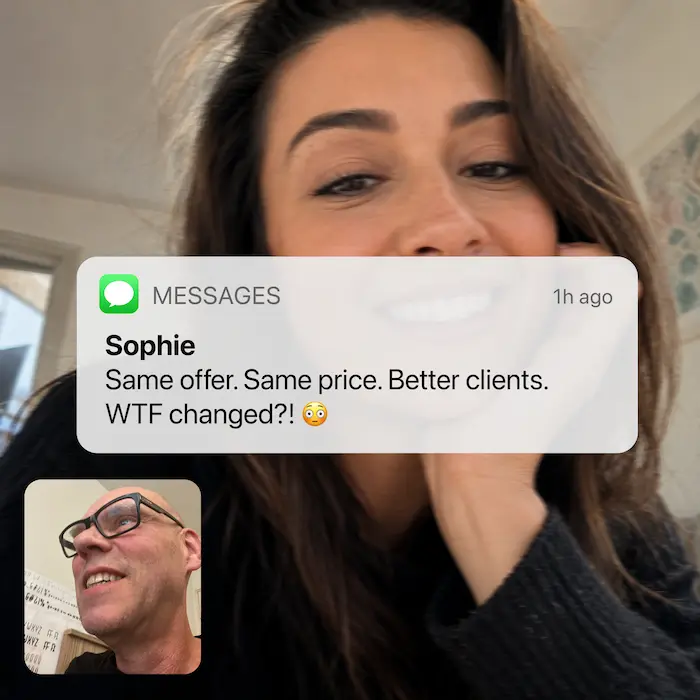

The message above is real.
Sophie sent it after changes to how she presented her business helped her attract better clients:
“Same offer. Same price. Better clients.
WTF changed?!”
- Nothing had changed about the quality of her work.
- She had not invented a new service.
- She had not lowered her prices.
- She had not added more sessions, bonuses or extras.
What changed was how quickly the right people could recognize themselves, understand the value and see which next step fitted them.
A short time earlier, I had reviewed Sophie’s homepage.
The problem became clear almost immediately.
Sophie already had a strong promise
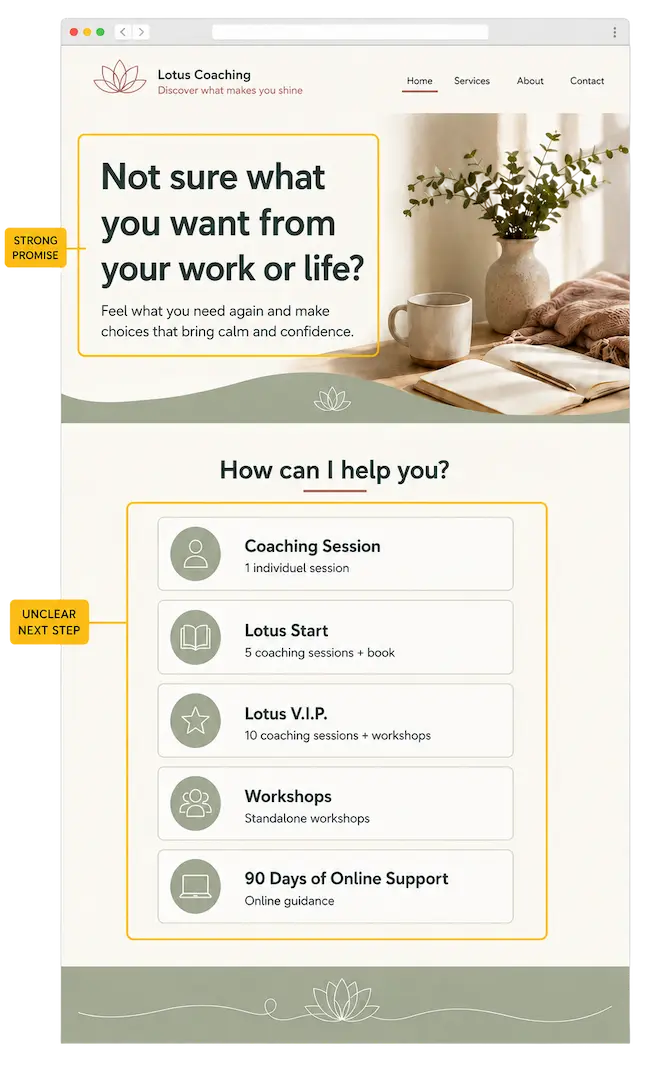
At the top of her homepage was this question:
“Not sure what you want from your work or life?”
That is strong.
It meets the visitor inside a real moment of doubt.
- Someone may feel stuck.
- Their head may be full.
- They may know something needs to change, but not yet know what that change should be.
Sophie then points towards a clear outcome:
- Feeling what is needed again.
- Making choices that bring more calm and confidence.
The right visitor can immediately think:
“This is about me.”
That is where trust begins.
But further down the page, something changed.
The person looking for clarity had to create it first
After that strong opening, the visitor had to choose between:
- Individual coaching sessions
- Lotus Start
- Lotus V.I.P.
- Workshops
- 90 days of online support
Each route offered a different form and amount of support.
But it was not immediately clear which situation made each route the right choice.
The options mainly told visitors:
- How the support was delivered
- How many sessions were included
- How long it lasted
- Which extras came with it
- What each option cost
The problem
The person visiting the website was there because they did not yet know what they needed.
But the page asked them to decide which solution they needed.
Someone searching for clarity first had to create that clarity alone.
That is when price comparison starts
When people clearly understand the difference between two options, they can choose based on fit.
When the difference is unclear, they look for something easier to compare.
- The number of sessions
- The length of each programme
- The added support
- And eventually, the price
Not because price is always their main concern.
But because price is the clearest difference they can see.
“People compare on price when they cannot clearly see the difference.”
That is an important distinction.
A business can have an excellent offer and still attract price shoppers.
The problem may not be the offer.
The problem may be how the value is being communicated.
Sophie did not need another offer
The obvious response might have been:
- To simplify everything into one service
- To add more explanation
- To include more sessions and bonuses
But Sophie did not need to rebuild her business.
Her strongest positioning was already there:
The central journey
From a full head to feeling what truly fits.
The change was to make every route feel like a logical step within that same journey.
Instead of asking visitors to compare packages, the page needed to help them recognize their situation.
The most important questions became:
- When is one coaching session the right starting point?
- For which situation is Lotus Start the logical next step?
- When does someone need the deeper support of Lotus V.I.P.?
- Who benefits most from 90 days of continued guidance?
Each route needed to begin with the person and their situation.
Only after that should the page explain the format, sessions and extras.
From “Which package?” to “This is my next step”
Before
Before the changes, a visitor could see several services and ask:
“Which one gives me the most for my money?”
After
After the changes, that same visitor could ask:
“Which route fits where I am now?”
That is a completely different buying decision.
- The services had not changed.
- The prices had not changed.
What changed was the way people understood the choice.
The page no longer asked visitors to solve the puzzle themselves.
It helped them recognize the right next step.
Price moved into the background.
Recognition, trust and the desired outcome moved forward.
And Sophie began attracting better-fit clients.
That is when her message arrived:
“Same offer. Same price. Better clients. WTF changed?!”
What actually changed?
Four things became clearer.
The visitor could recognize the problem
The page began with a real situation, not a service description.
The desired outcome became visible
The promise became calm, confidence and choices that feel right.
Each route gained a clear role
Sophie’s services became logical next steps within one clear journey.
The decision became easier
Visitors only had to recognize where they were and which route fitted.
They only needed to recognize:
“This is where I am.”
“This is the step that fits me.”
Better clients often appear before the offer changes
Many solo service businesses assume that attracting better clients requires a better package.
So they:
- Create another service
- Add more features
- Include more sessions
- Rewrite the pricing table
- Lower the price
But better clients are not always looking for more.
They are looking for a clear reason to believe:
“This person understands my situation.”
“This is the outcome I want.”
“This feels like the right next step.”
When those signals are missing, even a strong service can look interchangeable.
When those signals become clear, the same service can feel far more valuable.
That is why the same offer and the same price can begin attracting a different kind of client.
Check what your own website asks people to do
Look at the main services on your website.
Quick self-check
- Can someone tell within a few seconds who each option is for?
- Does every route begin with a recognizable situation?
- Or does it begin with sessions, features and deliverables?
- Is the difference based on the outcome?
- Or mainly on how much someone receives?
- Would a person who feels uncertain know where to begin?
If not, the problem may not be the offer.
It may be the signals around the offer.
And those signals shape who keeps reading, who trusts the business and who decides to make contact.
The right clients should not have to search for the difference.
Make it obvious before they start comparing.